
CitationDesk student workflow
Slide 1 of 10
1. Start with school
Create the academic home base.
CitationDesk begins with the structure students already understand: school, course, assignment. That keeps references, notes, and drafts from blending into one giant pile.
- Add the school profile.
- Store default citation expectations.
- Keep school-specific writing context close.
School Profile
Liberty University
2. Add the course
Put the paper inside the right class.
A course gives every paper a place to live. Sources for one class do not accidentally become clutter for another.
School
Liberty
Course
BUSI 701
Style
APA 7
3. Create the assignment
Turn requirements into the writing target.
CitationDesk treats the assignment as the center of the workflow: title, due date, citation style, word count, required sources, and Word template.
This is where the eventual completed paper begins. The source list, notes, and writing draft are scoped to this assignment.
Title
Trend Analysis Paper
Citation Style
APA 7 Student
Sources Needed
10
Export Target
Word .docx
4. Collect candidates
Bring sources in, then decide what belongs.
Sources can come from browser capture, DOI lookup, pasted references, downloaded citation files, or manual entry. The goal is not to save everything. The goal is to build a useful working set.
DOI verified • PDF found • Will use
DOI verified • Maybe
PDF found • Will use
5. Select sources
Use stoplights before you read everything.
Students often gather too many possible sources. CitationDesk supports triage: will use, maybe, and no. That makes it easier to keep strong sources and remove distractions.
- Will use: source has a clear role.
- Maybe: save for re-review.
- No: not relevant enough.
Will use
7
Maybe
3
No
0
6. Read and take notes
Read with the paper in mind.
CitationDesk keeps reading prompts near the source so notes are useful later: citation, summary, assessment, reflection, and how the source supports the assignment.
The point is not to copy the article. The point is to capture why the article matters to the paper.
Reading prompts
What does this source prove or suggest?
How does it connect to my thesis?
What limitation should I remember?
Summary: External monitoring increases the likelihood of detecting misconduct.
Use: Supports the governance oversight paragraph.
Caution: Applies best to firms with strong monitoring proximity.
7. Use notes as writing companions
Keep the evidence beside the draft.
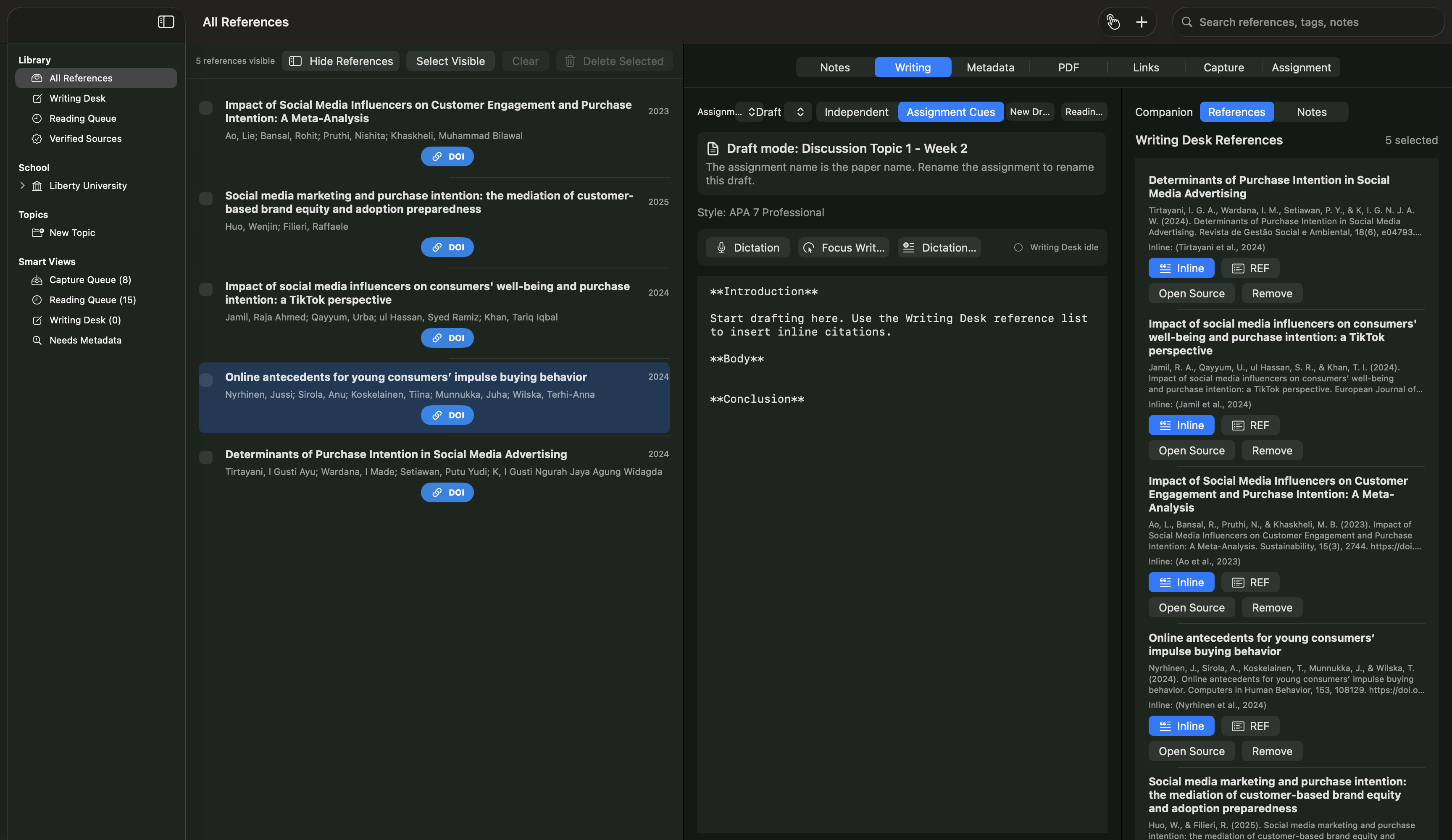
When the student moves to Writing Desk, notes and references become companion material. That keeps the draft grounded in the sources without switching between disconnected tools.
The student can pull ideas from notes, add citations, and keep the source list visible.
8. Draft with citations
Turn source notes into paper paragraphs.
CitationDesk supports writing commands and citation-aware drafting so the student can build the paper while preserving citation intent.
//inline Braun and Mueller (2025) becomes a citation in the exported draft.
Corporate governance research suggests that external monitoring can reduce misconduct when oversight is close enough to detect questionable behavior.
//inline Braun and Mueller (2025)
This supports the argument that governance ethics depends on both formal rules and practical accountability.
9. Choose style and export
Send the paper to Word with the correct style.
The assignment controls citation style and template selection. CitationDesk exports the draft, headings, title-page details, in-text citations, and reference list for Word polish.
10. Completed paper
Finish in Word, submit with confidence.
The exported paper is not a toy preview. It is a Word document the student can proofread, polish, and submit after checking formatting requirements.
Trend Analysis Paper
Student Name
School of Business
BUSI 701: Bible and the World of Business
Abstract
References
Braun, M. C., & Mueller, S. M. (2025). External corporate governance and corporate misconduct...
Cuomo, F., Mallin, C., & Zattoni, A. (2016). Corporate governance codes...